






Connecticut Pastoral: At Home With Masterpieces Of Americana.
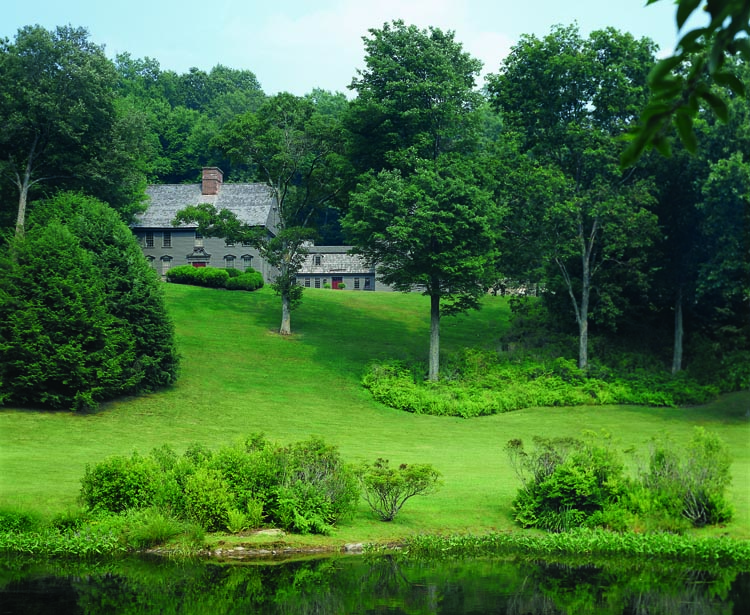
- A grand view of the residence, which is a union of five historic buildings.
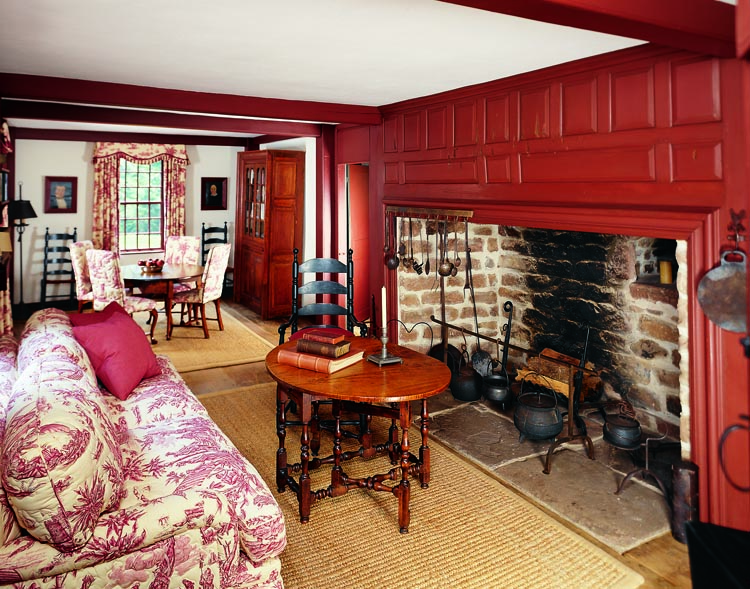
In most discussions about collections of antiques, the objects are the focus of attention. But in this instance, the collection includes the structures that house it as well. The five historic buildings that comprise this home were moved to the site in the 1970s and configured by the previous owner. They are: a rare and important mid-seventeenth-century ironmonger’s house, a converted early timber-frame barn, an elegant Federal dwelling, and a 1750 house and adjoining ell moved from Northford, Connecticut, and originally owned by the Reverend Warham Williams, the first pastor of the town’s Congregational Church and secretary of Yale College.
The structures are linked by a modern entry hall crafted with historic interior details to create seamless transitions between new and old. “The buildings are beautifully married together,” notes the current lady of the house. “I can’t believe how well it was done.” Tucked into the verdant Connecticut landscape, the home she shares with her husband showcases a fine collection of American, English, and continental furnishings, decorative arts, and art, dating principally from the mid-seventeenth to the late-eighteenth centuries.
|
|
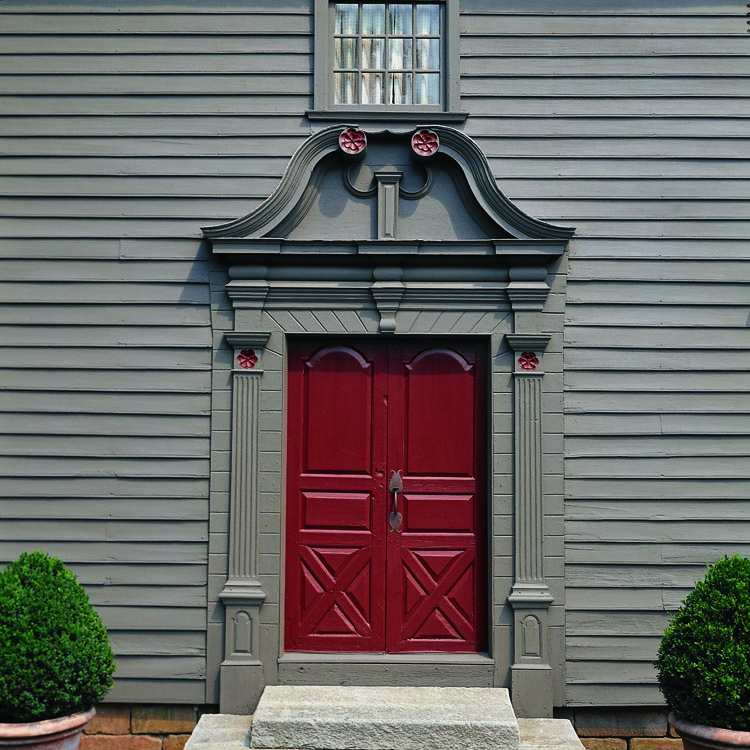
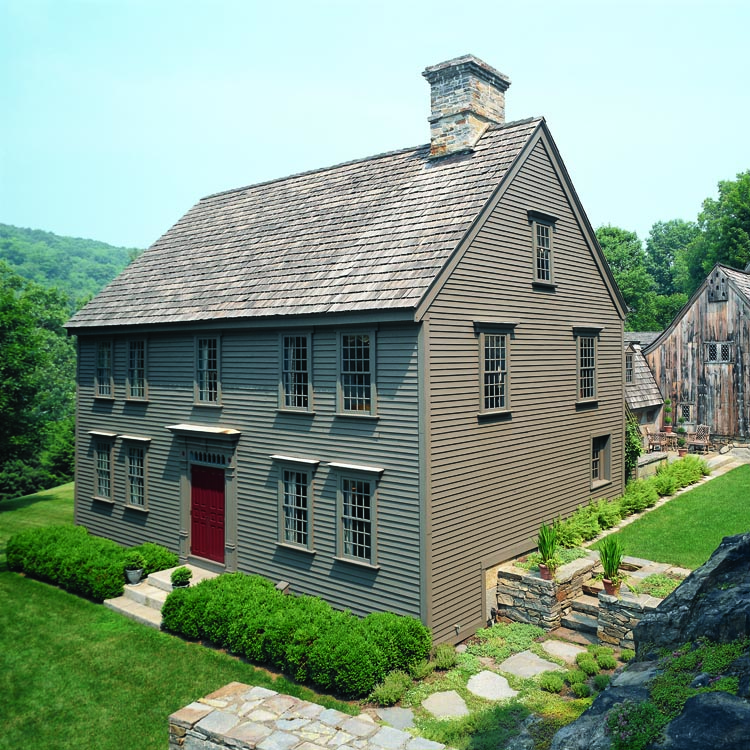
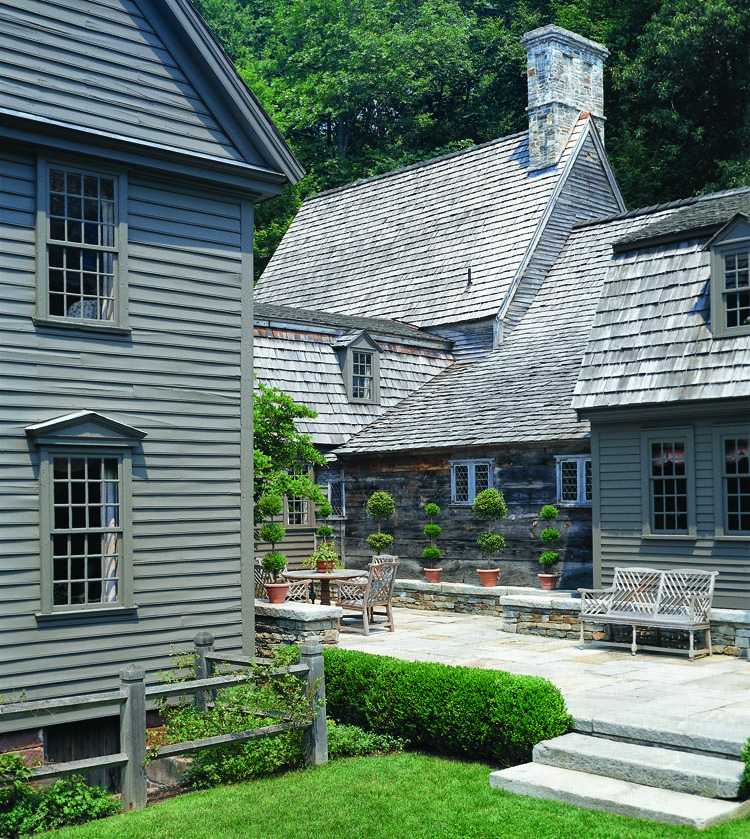
- Constructed in the shape of an uneven H surrounding a courtyard, the house comprises a 1750 Georgian manse and ell (at left), a steep-roofed mid-1600s ironmonger’s house (center), an antique barn with front lean-to (to its right), a modern entry (right), and a Federal-era house (not shown, far right). All period structures were moved from locations in Connecticut, except the ironmonger’s house, which originated in Massachusetts
Native Midwesterners who attended Connecticut colleges, the current owners had originally purchased a newer Connecticut country house, which they had revamped with period furnishings and details, including antique paneling acquired from antiques dealer Harold Cole of Woodbury, Connecticut. “We wanted a place to celebrate Thanksgiving and Christmas. We weren’t planning on living in Connecticut, but, the more time we spent here, the less we wanted to leave,” the wife notes. The area’s landscape and historic houses,” she says, “stole my heart. I didn’t realize how much this was really me.”
Though not in the market for a larger country property, the couple was smitten when they saw their current residence. Upon purchasing it some seven years ago, they upgraded its heating and cooling systems, re-did the lighting, updated bathrooms, renovated the kitchen with a period look, and had 13,000 square feet of existing antique wood floors hand stripped of the high gloss lacquer put on by the previous owner.
The interiors and furnishings were completed within twelve months. Much of this was accomplished with the help of California designer and preservationist John Cottrell, who had assisted the couple with previous residences. A visual artist herself, the lady of the house describes Cottrell as “a classic designer, one of the last true classic artists, who doesn’t follow trends.” She adds, “We would go through the antiques and art magazines, see the ads and go shopping. We’d get together with John, pile into the car and laugh all day. We would cover Connecticut, Massachusetts, Vermont, New York, and Pennsylvania looking for antiques; it was a whirlwind.” The dealers with whom they worked included Connecticut Americana dealers Peter and Jeffrey Tillou of Litchfield, the late Wayne Pratt and Harold Cole of Woodbury, and Buckley and Buckley of Salisbury. Massachusetts dealers included Samuel Herrup of Sheffield, Grace and Elliott Snyder of South Egremont, and Peter Eaton of Newbury. They also frequented H. L. Chalfant’s shop in Pennsylvania. “A day without buying is a day without trying,” the husband joked at the time.
|
|
|
|
|
|
|
|
|
|
|
|
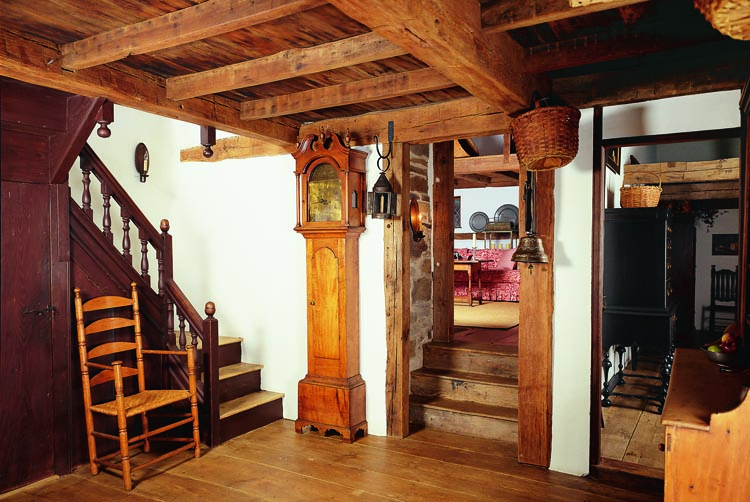
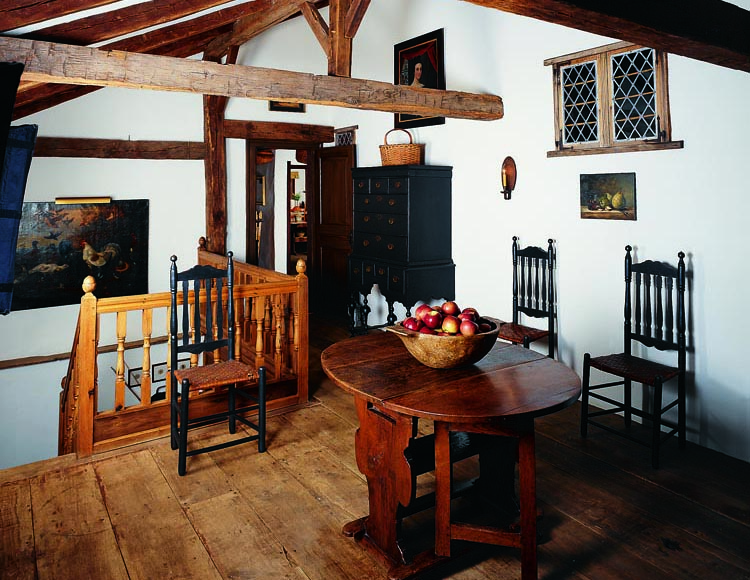
- This room in the ironmonger’s house connects via a short flight of stairs to a period barn containing a library sitting room; notice the thick stone wall, originally the exterior wall of the barn. The seventeenth-century structure features details typical of First Period construction: post-and-beam framing, exposed framing members, a floorboard ceiling, heavily turned balusters, and drops. A ladder-back armchair and unsigned maple tall case clock are among a small number of objects in the space.
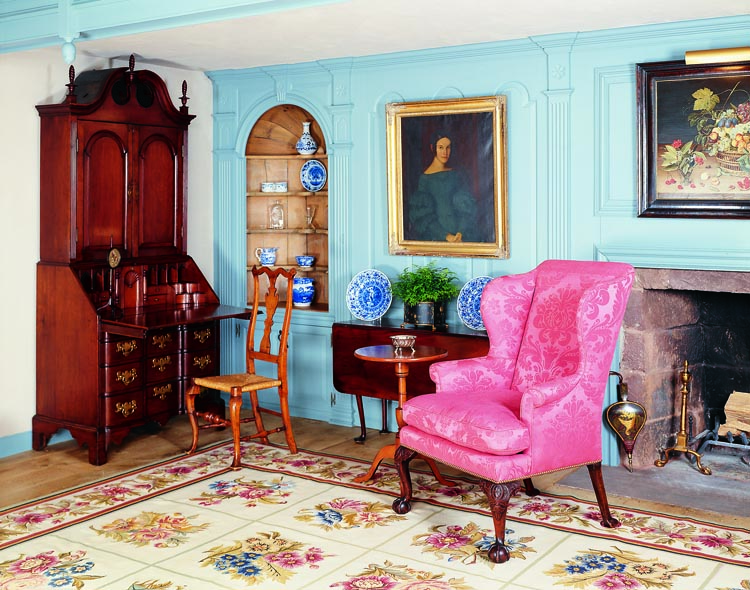
A businessman who appreciates art and antiques for their investment potential as well as their aesthetic value, the husband’s taste runs toward the European fine art and Hudson River School paintings that they collected for their first Connecticut house. Recognizing that their present environment calls for more emphasis on collections from New England, the European pieces are now mingled with objects more closely tied to the northern regions. That being said, the couple gravitates toward what they like. “We didn’t go looking for antiques or art with any particular objective. The house seems to tell us what it wants,” asserts the wife. Among her most cherished objects are early Delft ceramics, which she favors because of their soft coloration of reds, yellows, and blues, and because their aesthetic is appropriate to the house.
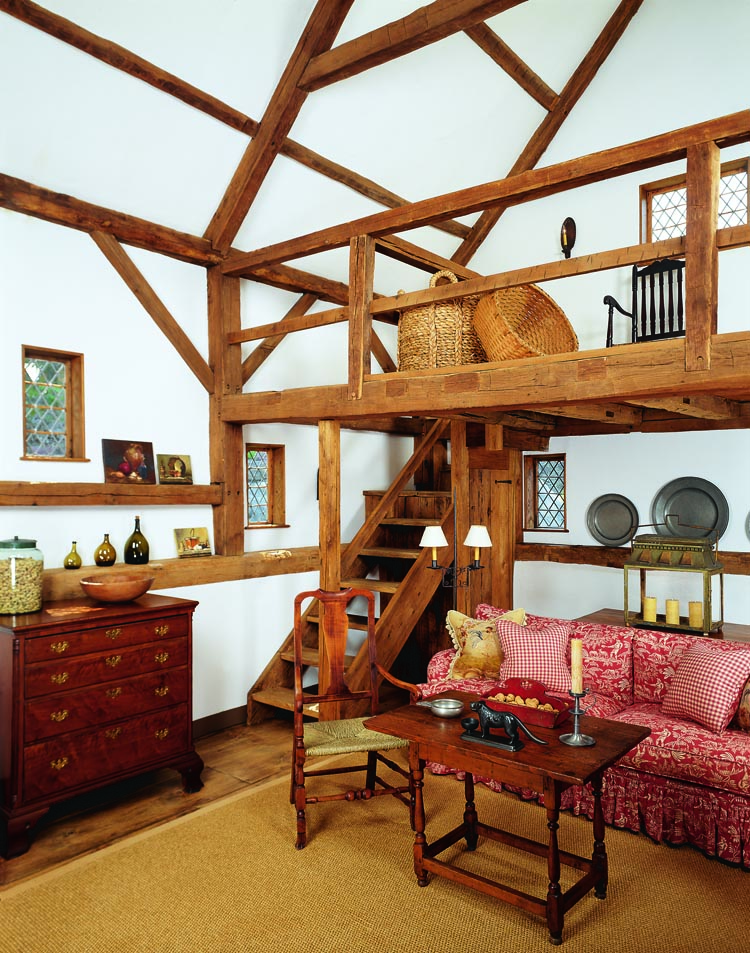
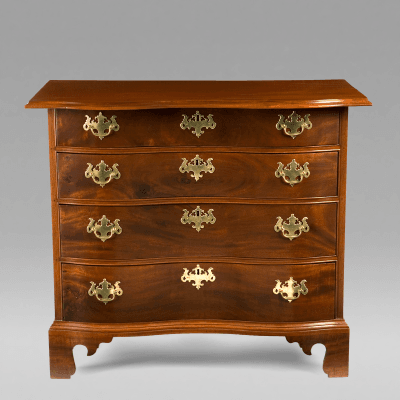
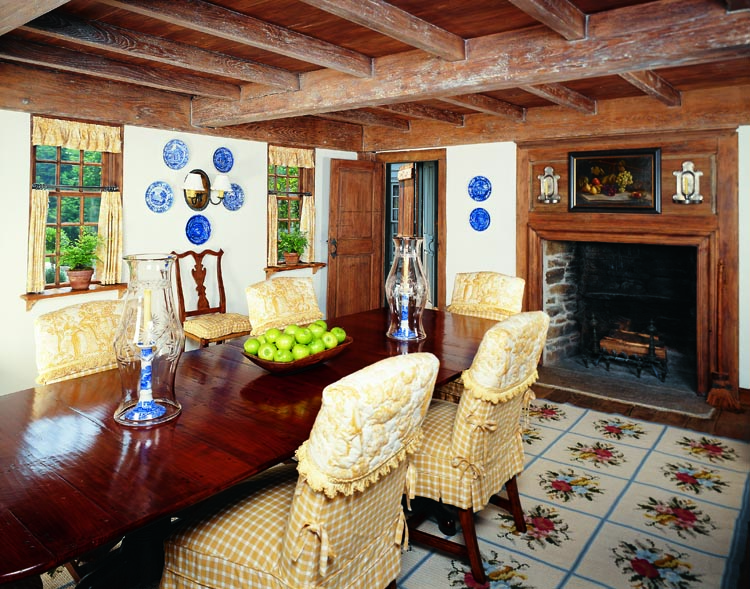
- The library is located in a restored barn, which exhibits exposed post-and-beam framing and casement windows. A simple staircase leads to a loft. The beams of the ground floor are perfect shelves for English pewter, blown glass bottles, and several paintings by the lady of the house. Furnishings include a Connecticut chest of drawers, Queen Anne armchair, and a maple tavern table, combined with a modern sofa upholstered in toile de Jouy.
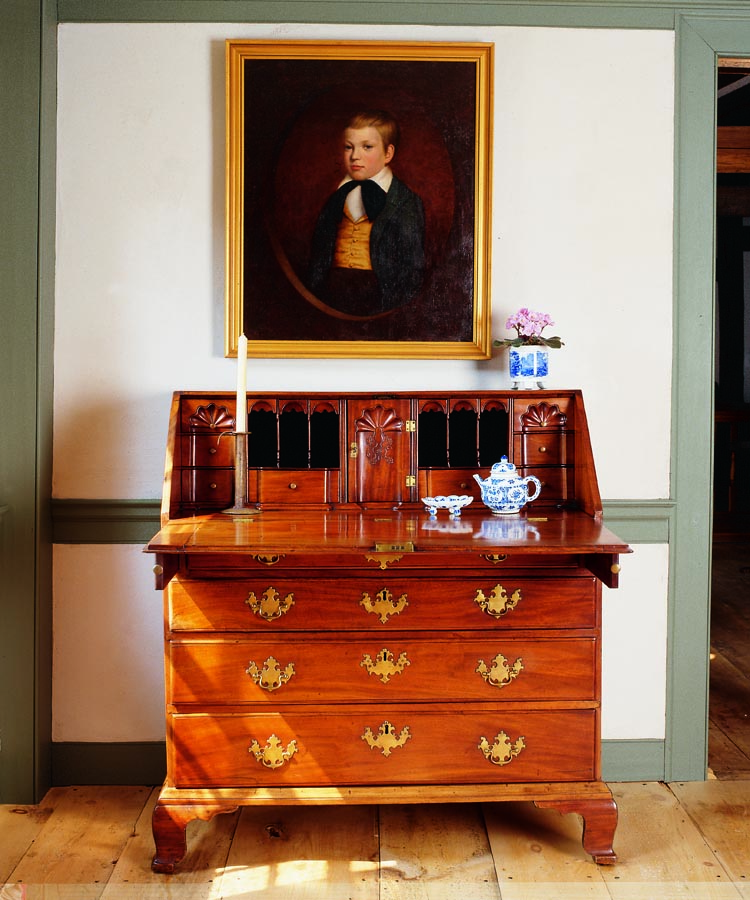
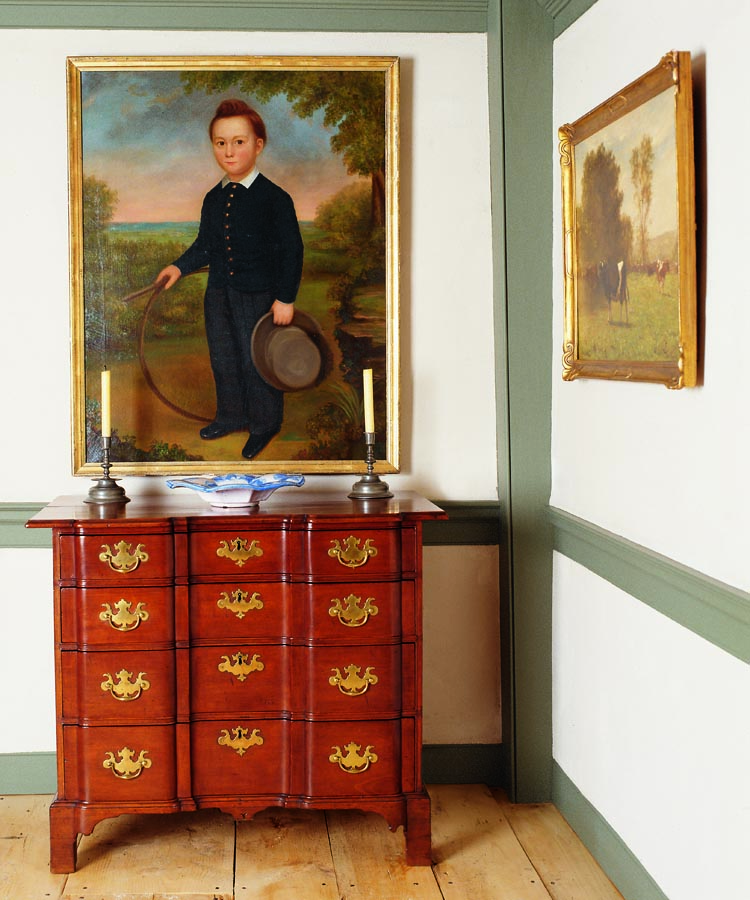
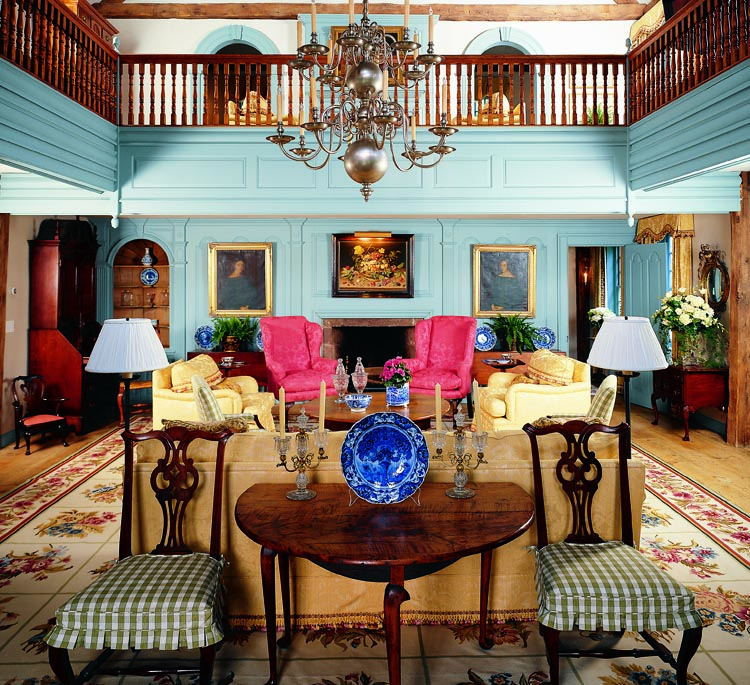
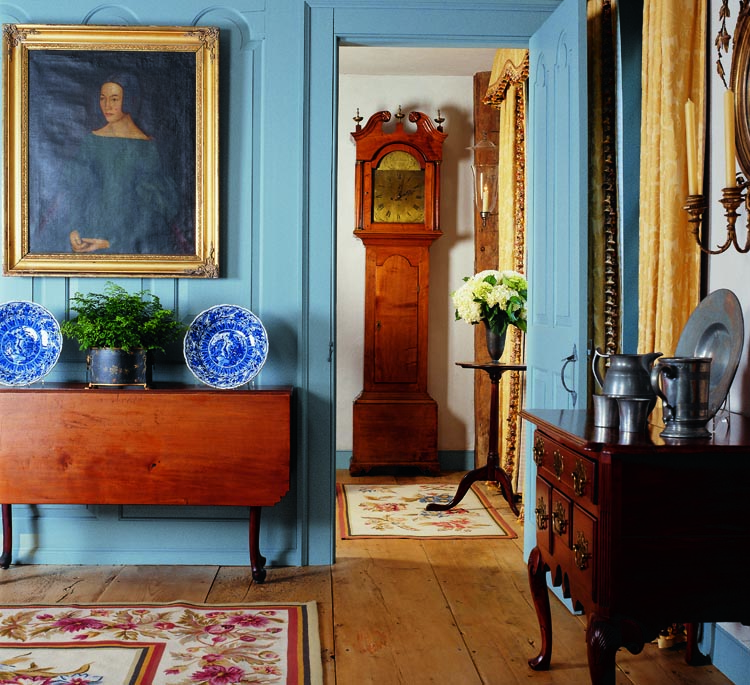
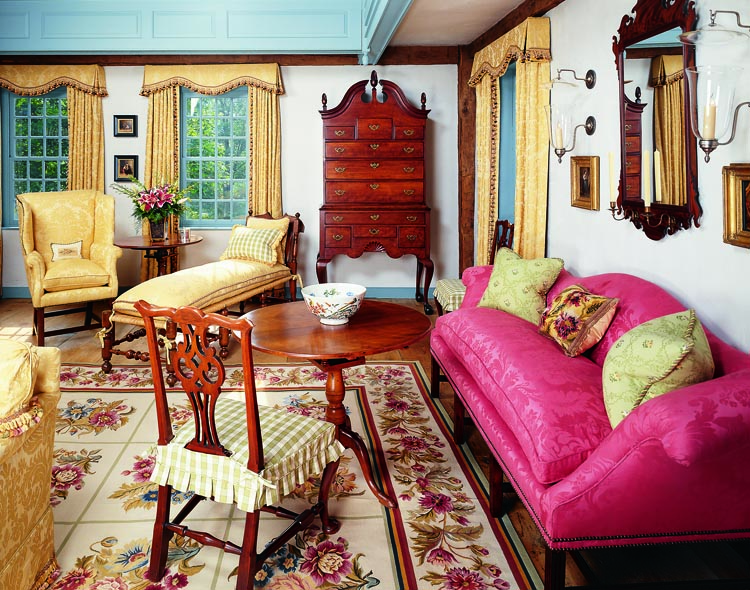
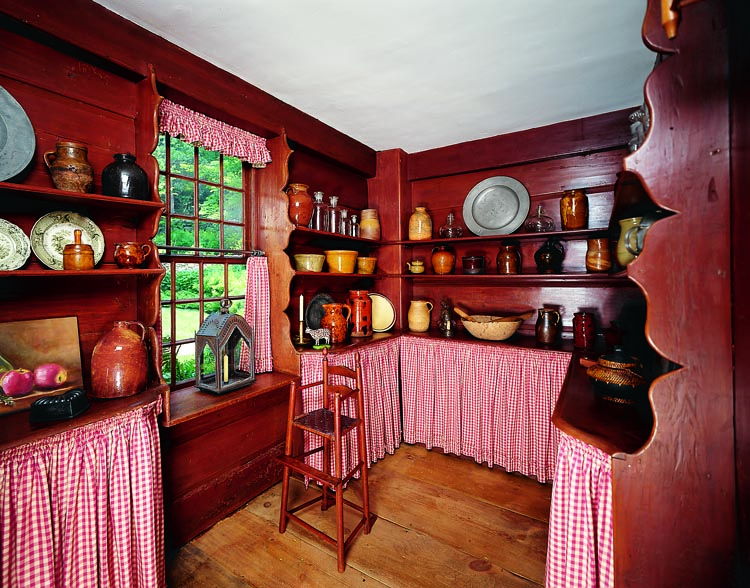
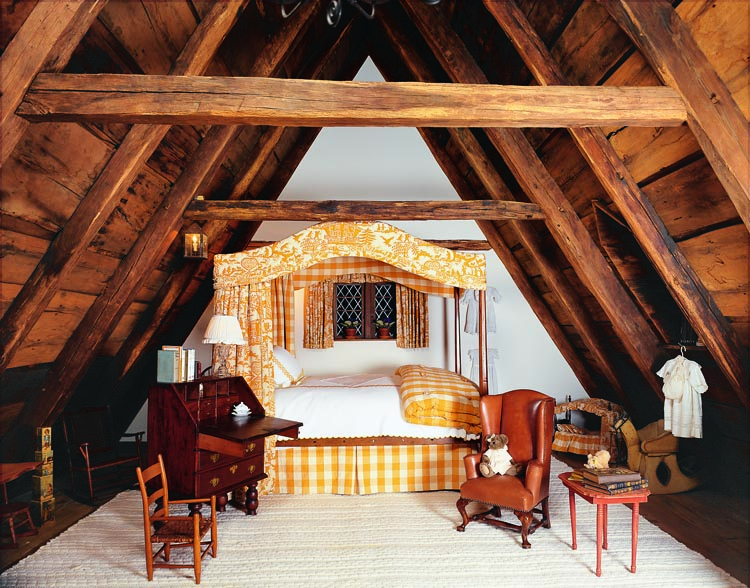
Following the classic idea of the hierarchy of rooms, the most elegant furnishings are in the main public rooms, while more rustic country furnishings are in the First Period rooms in the ironmonger’s house. Throughout the home there is an impressive array of tall clocks, case pieces, chairs, candle stands, and tables. In the Federal dwelling, a two-story space rimmed by a balcony (built by the previous owner) and referred to by the couple as the music room, commodious upholstered pieces create comfortable vantage points from which to admire the period furnishings. Lighting the room is a stately Dutch brass chandelier. Says Cottrell, who was at the house during the interview, “I like rooms that look like they happened over a long time; those that combine collections of many different periods and styles that work well together.
The wife has arranged the decorative objects in her home in appealing vignettes. “The house was much fuller,” she recalls. “As the decoration evolved, I thought of Coco Chanel, who said [when dressing to go out], ‘Put on your jewelry and take one thing off.’ In a house, you need to create space around the objects so they can be appreciated.”
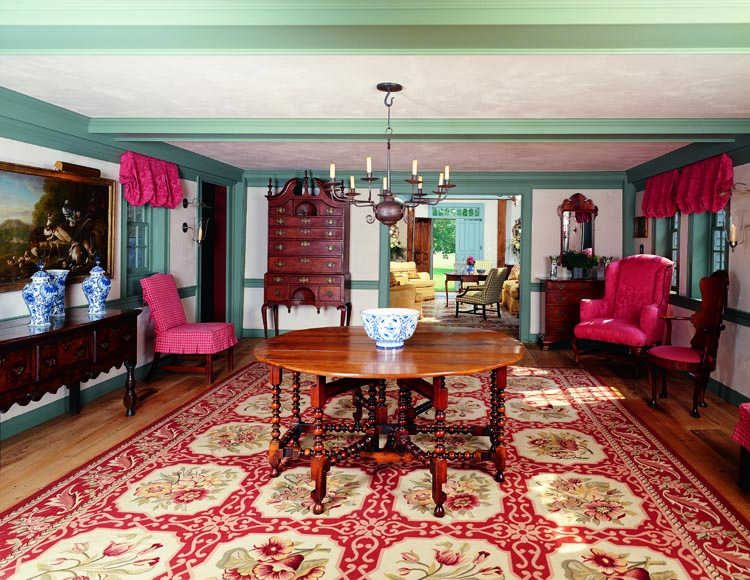
One favorite category of furnishings is antique side chairs, which, the wife remarks, “have such personality. They are as individual as people.” Following eighteenth-century custom, chairs are moved to accommodate varied activities as they occur. These include the small concerts the couple is fond of hosting, as well as dinners in the home’s formal entrance hall. “It’s fun to be able to eat anywhere in a house. Life is about change and different experiences,” Cottrell observes, adding, “A room is about interacting; how well it functions for two people or for many. Things must be grouped to allow variety and to encourage conversation. A room should always have comfort, interest and balance, and it should feel good to you.”
Upholstery for the modern seating furniture includes period-appropriate reproductions of eighteenth-century toiles de Jouy and furniture checks. Should the couple decide to paper the walls, the original paper for the Warham Williams house is in the collection of the Cooper-Hewitt Museum in New York, and could be used as reference. This couple chose paint; a soft palette of yellows, blues, reds, and greens on the woodwork to emphasize the architecture, white on the walls to showcase the collection. The golden yellow, which Cottrell describes as “a staple of eighteenth century ballrooms,” and the other colors used in the house, were drawn from historic colors yielded by paint analysis at Stratford Hall in Virginia.
This article was originally published in the 8th Anniversary issue of Antiques & Fine Art magazine, a fully digitized version of which is at afamag.com. AFA is affiliated with Incollect.com.