







Robert Gwathmey
American, 1903 - 1988
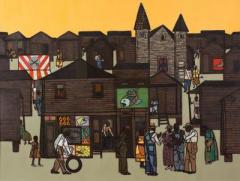
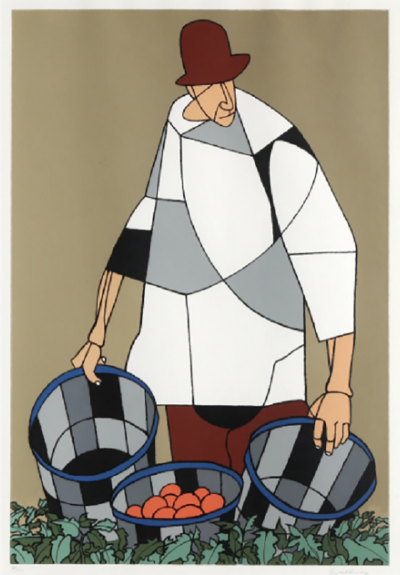
Born in Richmond, Virginia, Robert Gwathmey became an artist known for his Social Realist depictions of life in the rural South. He was one of the first white artists to create dignified images of African-American people and did so in a style that was modernist with geometric forms and bold coloration. The sharp outlines and flat planes of color also relate to stained glass window designs, which was a conscious reference.
Gwathmey moved north to study art, going first to the Maryland Institute of Art for a year and in 1930 earned a degree from the Pennsylvania Academy of Fine Arts. The artist also worked in a settlement house and became acutely aware of tensions between people from diverse cultures. His marriage to Rosalie Hook, an artist and photographer who did a documentary series on blacks in the South, became another source of inspiration.
Gwathmey traveled in Europe for two years and then taught at the Carnegie Institute of Technology and for twenty-six years at Cooper Union. In 1944, he received a Rosenwald Fellowship and lived and worked on a tobacco farm, another experience that motivated him to turn to rural south themes in his art. In 1973, he was elected to the National Institute of Arts and Letters and in 1976, to the National Academy of Design.
While Gwathmey spent most of his forty-five year career in New York City, he frequently returned to the South where he became concerned about the problems dividing blacks and whites.
Gwathmey moved north to study art, going first to the Maryland Institute of Art for a year and in 1930 earned a degree from the Pennsylvania Academy of Fine Arts. The artist also worked in a settlement house and became acutely aware of tensions between people from diverse cultures. His marriage to Rosalie Hook, an artist and photographer who did a documentary series on blacks in the South, became another source of inspiration.
Gwathmey traveled in Europe for two years and then taught at the Carnegie Institute of Technology and for twenty-six years at Cooper Union. In 1944, he received a Rosenwald Fellowship and lived and worked on a tobacco farm, another experience that motivated him to turn to rural south themes in his art. In 1973, he was elected to the National Institute of Arts and Letters and in 1976, to the National Academy of Design.
While Gwathmey spent most of his forty-five year career in New York City, he frequently returned to the South where he became concerned about the problems dividing blacks and whites.