






Listings / Fine Art / Paintings / Still Life



Offered by:
Thomas Gallery Ltd.
315 East 91 Street, 6th floor
New York City, NY 10128 , United States
Call Seller
917.434.4032
Showrooms
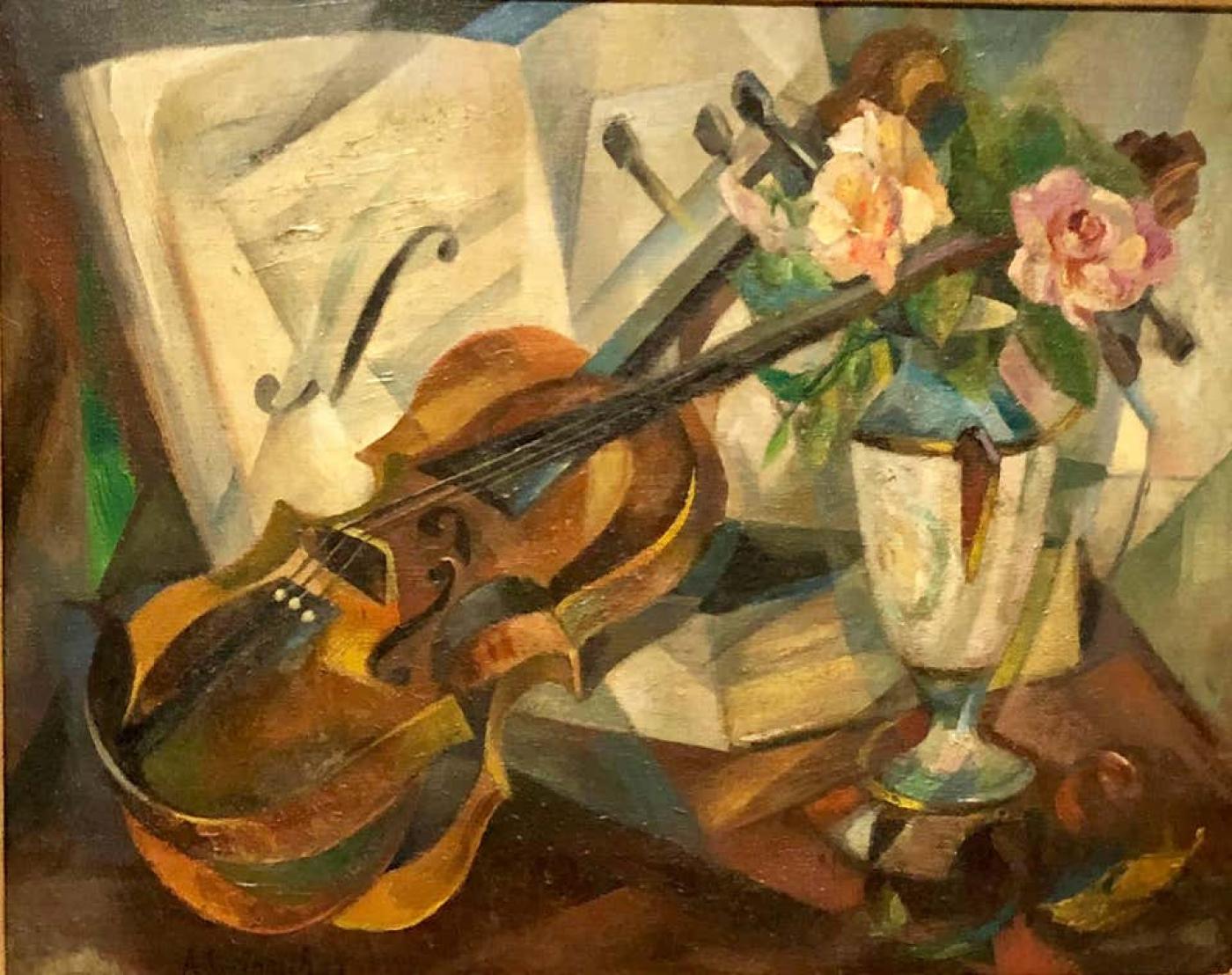
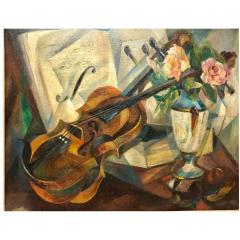
Cubist Still Life "Violin" by Agnes Weinrich, Signed, Dated 1922
-
Description
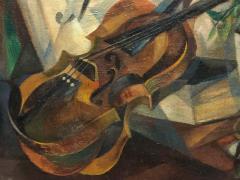
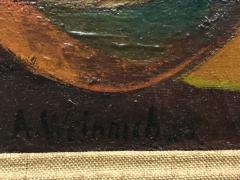
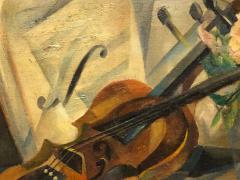
Still life painting (Violin, Flowers), Oil on canvas, by Agnes Weinrich, Signed and dated "22", Unframed: 20" x 16", Framed 27.5 x 23".
Agnes Weinrich (1873-1946) was an early female, American modernist artist at a time when there was little interest in Modern Art in the USA and when few women were artists. She was a ground breaker in modern art. She was one of the first American artists to make works of art that were modernist, abstract, and influenced by the Cubist style. She was also an energetic and effective proponent of modernist art in America, joining with like-minded others to promote experimentation as an alternative to the generally conservative art of their time. Despite the quality of her work and despite the energy and skill with which she worked both to develop her own talent and to further the progressive movement in American art, Weinrich received little recognition during her lifetime and is only recently being recognized for her leadership as an important female artist bringing the modern movement to the USA. The painting shown is an important example of her mature phase of her work.
Exhibitions
This is a selective list of exhibitions in which she participated during her life. Its main source is Louise Noun's article on Weinrich in Woman's Art Journal, supplemented by contemporary news accounts in The New York Times, the Brooklyn Daily Eagle, the New York Evening Post, The Philadelphia Inquirer, and The Christian Science Monitor.
1915 onward: Provincetown Art Association
1917: Pennsylvania Academy of Fine Arts
1917: Pennsylvania Academy of Fine Arts, Philadelphia
1917-23: Society of Independent Artists, New York
1919: Art Institute of Chicago
1920: Boston Arts Club
1926 onward: New York Society of Women Artists
1928: Grace Horn Gallery, Boston
1929: Pennsylvania Academy of Fine Arts, Philadelphia
1932: Boston Public Library
1936: Harley Perkins Gallery, Boston (solo)
1938: Boston Society of Independent Artists
1938: Washington Public Library, Washington, D.C.
1939: Corcoran Gallery Biennial, Washington, D.C.
1939: Fogg Art Museum Twentieth Century Club, Boston
1939: Witherstine Gallery, Boston
1939: Institute of Modern Art, Boston
1945: Woljeska Gallery, Brooklyn, New York
A Detailed Biography follows:
Agnes Weinrich was born in 1873 on a prosperous farm in south east Iowa. Both her father and mother were German immigrants and German was the language spoken at home. Following her mother's death in 1879 she was raised by her father, Christian Weinrich. In 1894, at the age of 59, he retired from farming and moved his household, including his three youngest children—Christian Jr. (24), Agnes (21), and Lena (17), to nearby Burlington, Iowa, where Agnes attended the Burlington Collegiate Institute from which she graduated in 1897.[1][2][3] Christian took Agnes and Lena with him on a trip to Germany in 1899 to reestablish links with their German relatives. When he returned home later that year, he left the two women in Berlin with some of these relatives, and when, soon after his return, he died, they inherited sufficient wealth to live independently for the rest of their lives.
Either before or during their trip to Germany Lena had decided to become a musician and while in Berlin studied piano at the Stern Conservatory. On her part, Agnes had determined to be an artist and began studies toward that end at the same time.[1][4] In 1904 the two returned from Berlin and settled for two years in Springfield, Illinois, where Lena taught piano in public schools and Agnes painted in a rented studio. At this time Lena changed her name to Helen. In 1905 they moved to Chicago where Agnes studied at the School of the Art Institute of Chicago under John Vanderpoel, Nellie Walker, and others.
In 1909 Agnes and Helen returned to Berlin and traveled from there to Munich, where Agnes studied briefly under Julius Exter, and on to Rome, Florence, and Venice before returning to Chicago.[5] They traveled to Europe for the third, and last, time in 1913, spending a year in Paris. There, they made friends with American artists and musicians who had gathered there around the local art scene. Throughout this period, the work Agnes produced was skillful but unoriginal—drawings, etching, and paintings in the dominant academic and impressionist styles.
On her return from Europe in 1914, she continued to study art, during the warm months of the year in Provincetown, Massachusetts,[1] where she was a member of the Provincetown Printers art colony in Massachusetts,[6] and during the colder ones in New York City. In Provincetown she attended classes at Charles Hawthorne's Cape Cod School of Art and in New York, the Art Students League.
In 1930 Weinrich put together a group show for modernists at the GRD Gallery in New York. The occasion was the first time a group of Provincetown artists exhibited together in New York. For it she selected works by Knaths, Charles Demuth, Oliver Chaffee, Margarite and William Zorach, Jack Tworkov, Janice Biala, Niles Spencer, E. Ambrose Webster, and others.
Although she had led a full and productive life devoted to development of her own art and to the advancement of modernism in art, she did not cease to work toward both objectives. She continued to work in oil on canvas and board, pastel and crayon on paper, and woodblock printing. Her output continued to vary in subject matter and treatment. For example, Still Life with Leaves, circa 1930 (oil on canvas, 18 x 24 inches) contains panels of contrasting colors with outlining similar to Knaths's style. Movement in C Minor, circa 1932 (oil on board, 9 x 12 inches) is entirely abstract. It too relates to Knaths's work, both in treatment (again, outlined panels of contrasting colors) and in its apparent relationship to music, something in which Knaths was also interested. Fish Shacks, circa 1936 (monochrome woodblock print) is severely abstract and has a strong Cubist feel. Untitled Abstraction, circa 1938 (oil on canvasboard, 12.25 x 12 inches) is very different from the abstract work of the earlier 1930s. It is a geometric abstraction showing influence of Wassily Kandinsky[33] consisting of rectilinear color panels in cool tones with to contrasting panels in ochre and red. Floral Still Life, circa 1940 (Crayon on paper, 7 x 9.5 inches) contains a frame within a frame, emphasizing the surface plane dramatically, and is also entirely abstract. Its composition consists of star-like shapes in blue and magenta in a lively pattern against a dark, textured background. -
More Information
Documentation: Signed Origin: United States Period: 1920-1949 Materials: Oiled Canvas, Paint. Condition: Good. Wear consistent with age and use. Creation Date: 1922 Styles / Movements: Modernism Incollect Reference #: 422870 -
Dimensions
W. 20 in; H. 16 in; D. 0.1 in; W. 50.8 cm; H. 40.64 cm; D. 0.25 cm;
Message from Seller:
T. Thomas Gargiulo came from a dual background as a Ph.D. in Psychology with extensive training in Art History and Anthropology to form Thomas Gallery in downtown Manhattan in 1997 to balance intellectual with design pursuits. Since its inception the gallery has seen decorative arts as a vibrant representation of human culture of each age and as a portal to understanding it. P: 917.434.4032 E: thomasgalleryltd@gmail.com
More Listings from Thomas Gallery Ltd. View all 1087 listings
-
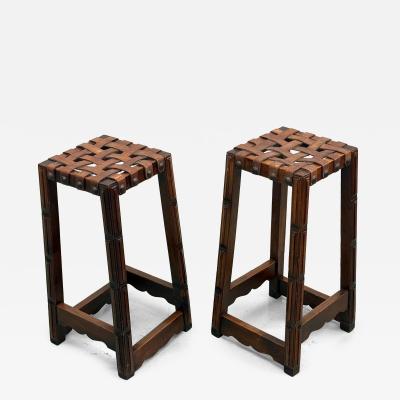
Pair of French Modern Craftsman Leather Strap Bar Stools, Jean MIchel Frank 1940
-
Set of 4 Italian Mid-Century Handmade Hardwood Stools, style Jean Michel Frank

-
2 Italian Mid-Century Modern Commodes or Chests of Drawers, Circle of Gio Ponti

-
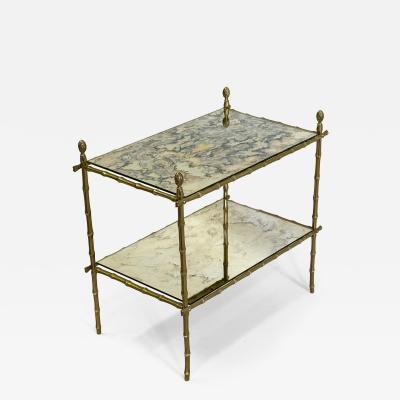
French Midcentury Brass Faux Bamboo & Patinated Mirror Side Table, Maison Bagues
-
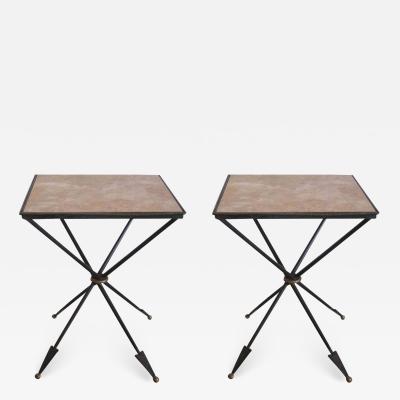
Pair of French 1940s Style Modern Neoclassical Gueridons / Side Tables
-
Rare French Modern Neoclassical Gilt Iron Square Coffee Table by Maison Ramsay

-
Mid-Century Partial Gilt Wrought Iron Coffee Table Attributed to Raymond Subes

-
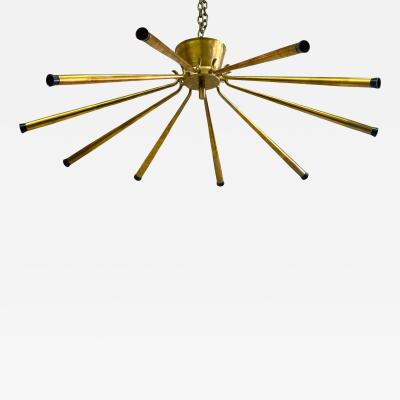
Italian Mid-Century Modern Brass Flush Mount / Pendant, Sunburst, by Stilnovo
-
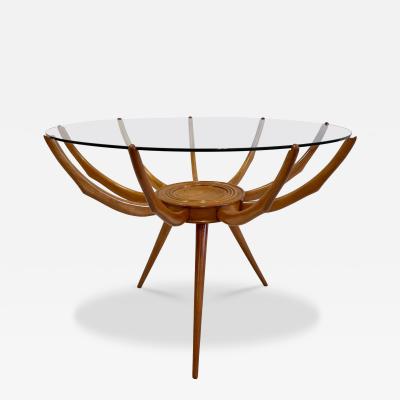
Iconic Italian Mid-Century Modern Spider Side or Coffee Tables by Carlo di Carli
-
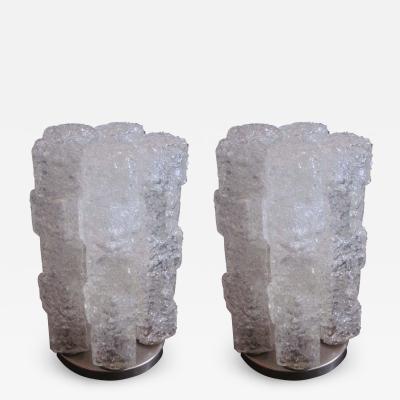
Pair Italian Mid-Century Modern "Ice Cube" Glass Table Lamps, Venini
-
French Mid-Century Hand-sewn Black Leather Coffee Table by Jacques Adnet

-
Pair Italian Mid-Century Modern Hand Blown Murano Ice Glass Sconces by Mazzega

-
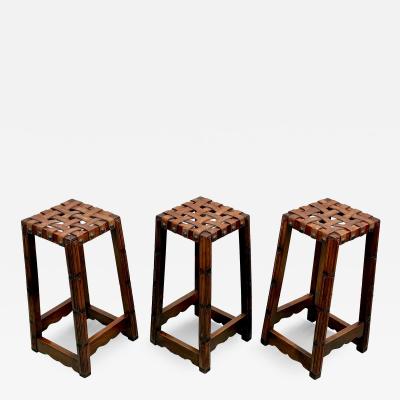
Set, 3 French Modern Craftsman Leather Strap Bar Stools, Jean Michel Frank, 1940
-
Three French Mid-Century Wrought Iron Floor Lamps Attributed to Raymond Subes

