








John Wells James
American, 1873 - 1951
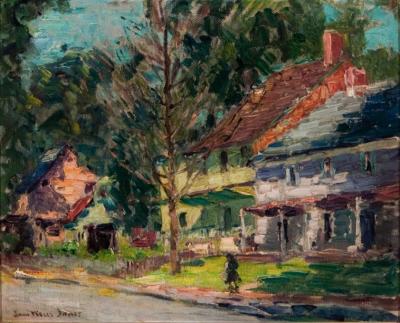
A master of both landscape and still life painting, Brooklyn born, John Wells James was a significant member of the New Hope Art Colony. He was the President of a successful wholesale drug company in Brooklyn, New York of which he owned in partnership with his three brothers. Although James had spent time studying with several fellow artists such as Max Kuehne and James Knox, he was proclaimed to be largely a self-taught artist.
James purchased a summer home in Solebury, near New Hope in the 1920’s. Dividing his time between New Hope and Brooklyn, James maintained studios in both locations. He is remembered most for his tightly constructed impressionist landscapes of picturesque scenery along the Delaware River. Colorful and fresh, his painterly canvases resonated with collectors amongst the art community. He exhibited frequently at the Phillips Mill with the New Hope crowd as well as in New York at the Salmagundi Club and the National Academy of Design. He also exhibited at the Pennsylvania Academy of the Fine Arts, the Carnegie Institute, and the Corcoran of Art.
James, passionate about flowers created a fairly substantial body of still life paintings. These delicate compositions were carefully created as the artist studied his subject in the same way a portrait painter would study his sitter. His goal was to capture the individuality and expression of each flower which had been gathered from the garden of Jame’s Solebury home.
A great inspiration to James was artist, Ernest Lawson, whom was said to be his favorite painter. James spent time in New England as well as abroad on various painting excursions. He was especially fond of Spain. Also among his talents, was frame making, an art which he most likely learned from close friend, Max Kuehne. John Wells James died in 1951 while traveling in France.
- American Artist, June, 1945
- Bianca Gallery Archives, 1995
James purchased a summer home in Solebury, near New Hope in the 1920’s. Dividing his time between New Hope and Brooklyn, James maintained studios in both locations. He is remembered most for his tightly constructed impressionist landscapes of picturesque scenery along the Delaware River. Colorful and fresh, his painterly canvases resonated with collectors amongst the art community. He exhibited frequently at the Phillips Mill with the New Hope crowd as well as in New York at the Salmagundi Club and the National Academy of Design. He also exhibited at the Pennsylvania Academy of the Fine Arts, the Carnegie Institute, and the Corcoran of Art.
James, passionate about flowers created a fairly substantial body of still life paintings. These delicate compositions were carefully created as the artist studied his subject in the same way a portrait painter would study his sitter. His goal was to capture the individuality and expression of each flower which had been gathered from the garden of Jame’s Solebury home.
A great inspiration to James was artist, Ernest Lawson, whom was said to be his favorite painter. James spent time in New England as well as abroad on various painting excursions. He was especially fond of Spain. Also among his talents, was frame making, an art which he most likely learned from close friend, Max Kuehne. John Wells James died in 1951 while traveling in France.
- American Artist, June, 1945
- Bianca Gallery Archives, 1995
 Loading...
